Listen to this article
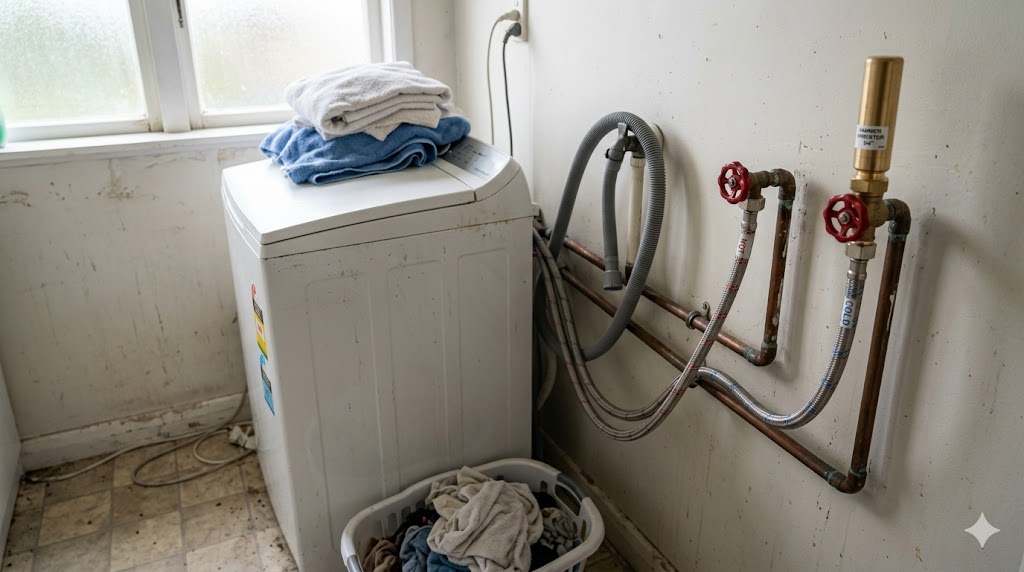
That sudden thud or bang when you turn off a tap — or when the washing machine finishes its cycle — is called water hammer. It is one of the most common plumbing sounds homeowners notice, and most people assume it is harmless. It is not. If left unchecked, water hammer can lead to a burst pipe or serious fitting failure.
What Is Water Hammer?
Water hammer occurs when fast-flowing water is suddenly stopped or redirected. The momentum of the water has to go somewhere — it sends a pressure shockwave back through the pipes. In mild cases this produces a single thud; in severe cases it can sound like someone hitting your pipes with a hammer repeatedly.
The physics are straightforward: water is incompressible. When it is stopped abruptly, all that kinetic energy converts to a pressure spike that travels through the pipework.
What Causes It?
Fast-Closing Valves
Modern solenoid valves — in washing machines, dishwashers, and irrigation systems — close almost instantaneously when the cycle ends. This is the most common trigger for water hammer in Auckland homes. You hear the thud right as the washing machine switches from fill to spin.
High Water Pressure
Higher mains pressure means more energy in the moving water — and a bigger shockwave when it stops. Auckland has relatively high mains pressure in many areas. If your home does not have a pressure reducing valve, or the valve has failed, you may have higher pressure than ideal running through your pipes.
Loose Pipes
Pipes that are not properly secured to the framing can amplify the sound of water hammer significantly. The pipe moves when the shockwave hits, and it bangs against the wall or framing. The water hammer itself may be mild, but the loose pipe makes it sound much worse.
Long Pipe Runs
Long, straight pipe runs with no change in direction build up more water momentum than shorter runs. High-rise buildings are particularly prone to this.
Why Does It Matter?
Water hammer is not just annoying — it causes real damage over time:
- Joint and fitting fatigue: Repeated pressure spikes stress every joint, elbow, and fitting in the system. Over years, this fatigues the joints and they begin to leak or fail.
- Appliance damage: Solenoid valves in washing machines and dishwashers, and fill valves in toilets, can be damaged by repeated pressure spikes.
- Pipe damage: In severe cases, repeated water hammer can cause pipes to crack or fittings to pull apart.
- Hot water cylinder damage: The tempering valve and connections on your cylinder are also subject to the repeated stress.
How to Fix Water Hammer
Water Hammer Arrestors
The most effective solution. A water hammer arrestor is a small device installed on the supply line near the offending valve. It contains a piston or bladder that absorbs the pressure spike. Common installation points are near washing machine connections and dishwasher supply lines.
Pressure Reducing Valve
If high water pressure is contributing to water hammer, installing or adjusting a pressure reducing valve (PRV) at the main inlet can make a significant difference. The target pressure for residential homes is around 350kPa — above 500kPa and water hammer becomes more likely and more severe.
Securing Loose Pipes
If the noise is primarily caused by pipes moving, adding pipe clips or securing existing loose clips eliminates the mechanical noise even if the pressure spike persists.
Air Chambers
An older solution — a short capped pipe stub on the supply line provides an air cushion that absorbs the pressure wave. These work but gradually become waterlogged and lose effectiveness. Modern arrestors are more reliable.
Can I Ignore It?
Mild water hammer in a modern home with newer pipes and fittings may not cause immediate problems. But in an older home with galvanised or copper pipes that already have weakened joints, it is accelerating the failure of those joints. And in any home, it is unnecessary wear on appliances and fittings.
It is worth fixing — it is usually not expensive and the solution lasts for years. If you notice signs of a water leak alongside banging pipes, get it checked sooner rather than later.
Getting Your Pipes Sorted
Water and Gas Worx diagnoses and fixes water hammer in Auckland homes. We can test your water pressure, install hammer arrestors, and identify any loose pipes or joints that have been stressed by the problem. If the damage is extensive, we can also handle full pipe replacement. As a licensed plumber and gas fitter, we cover all your plumbing needs across Auckland. See our full areas we service.
Call 0800 322 322 or email [email protected]
Frequently Asked Questions
Is water hammer dangerous?
Water hammer itself is not immediately dangerous, but over time the repeated pressure spikes can fatigue pipe joints, damage fittings, and even crack pipes. In severe cases it can lead to burst pipes and water damage.
How much does it cost to fix water hammer?
Our rate is $155 plus GST for the first hour, then $100 plus GST per hour after that. After-hours is $295 plus GST for the first hour, then $100 plus GST per hour after that. Public holidays are $395 plus GST for the first hour, then $100 plus GST per hour after that. We can quote before starting so you know the cost upfront. Most water hammer fixes involve installing an arrestor or adjusting pressure, which is typically a straightforward job.
Can I fix water hammer myself?
You can check for loose pipes and ensure your washing machine hoses are secure. However, installing water hammer arrestors and adjusting pressure reducing valves should be done by a licensed plumber to ensure it is done correctly and to code.
Why does water hammer happen when the washing machine stops?
Washing machines use solenoid valves that close almost instantaneously when switching between cycles. This sudden stop creates a pressure shockwave in the pipes. Installing a water hammer arrestor near the washing machine connection is the most effective fix.