Listen to this article
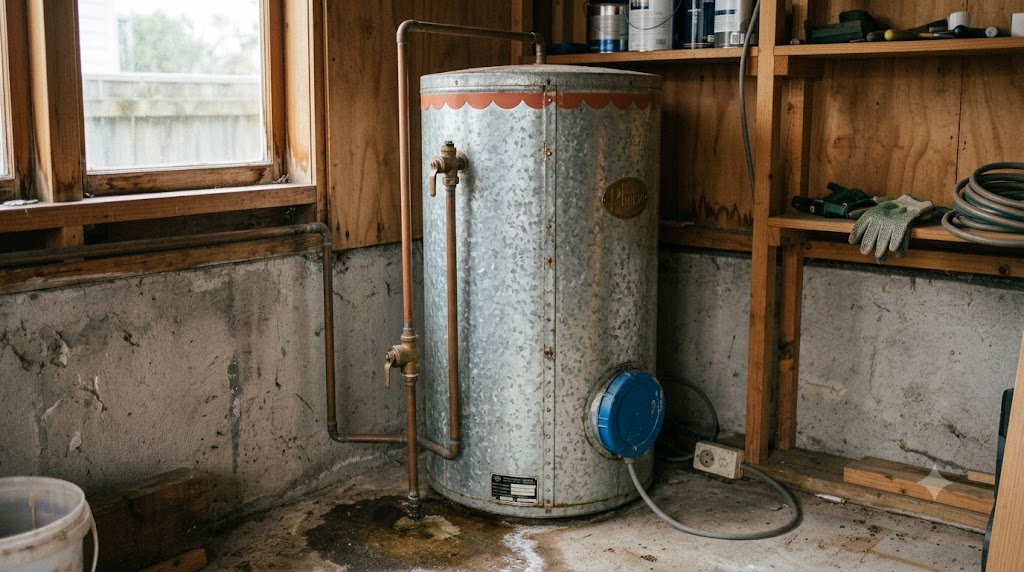
Hot water cylinders fail more often in winter for one simple reason: they are working harder. The water entering your cylinder from the mains is much colder in July than in January, so the element runs longer and more often to heat it — and that extra load is what pushes a tired cylinder over the edge. If your cylinder is going to fail, winter is when it usually happens. Here is why, and how to avoid being caught out.
Colder Incoming Water Means More Work
Your cylinder has to lift the incoming water up to temperature. In summer the mains water might arrive at 18 to 20 degrees; in winter it can be closer to 10. That is a much bigger temperature jump, so the heating element runs longer for every tankful. A cylinder that just kept up in summer can run short in winter, and components under constant load are more likely to fail.
The Common Winter Failures
- Element and thermostat: The hardest-working parts. A failing element often shows up as water that is lukewarm or takes far longer to reheat. A faulty thermostat can leave you with no hot water at all, or water that is too hot.
- Sediment build-up: Over years, minerals settle in the bottom of the tank, insulating the element from the water and making it work harder and run hotter. This shortens its life and reduces how much usable hot water you get.
- Old age: Most electric cylinders last around 10 to 15 years. An older tank that has been quietly declining often gives up under winter load. Rust-coloured water or a damp patch under the cylinder are warning signs.
- Pressure relief valves: The valve weeps or seizes — sometimes the first visible sign something is wrong.
Warning Signs to Watch For
Catching a cylinder before it fails completely saves you a cold-shower scramble. Watch for hot water running out faster than it used to, taking longer to reheat, fluctuating temperature, rusty or discoloured hot water, or any moisture around the base of the tank. We cover these in detail in 5 signs your hot water cylinder needs replacing.
How to Avoid a Mid-Winter Failure
If your cylinder is over 10 years old or showing any of the signs above, the smart move is to have it checked or replaced before peak winter demand rather than after it dies. Replacing on your terms — booked in, planned, with the right cylinder chosen — is far better than an emergency replacement on a freezing morning.
If you are replacing anyway, it is also the moment to consider whether a different system suits you better. Our guide on hot water cylinder vs continuous flow compares the options.
Hot Water Repairs and Replacement Across Auckland
Water and Gas Worx repairs and replaces hot water systems across Auckland — cylinders, continuous flow and heat pump hot water. If you have lost hot water, our emergency plumber service is available 24/7. See our hot water services and areas we service.
Call 0800 322 322 or email [email protected].
Frequently Asked Questions
Why does my hot water run out faster in winter?
Because the incoming mains water is much colder, your cylinder has to work harder to heat each tankful and takes longer to recover between uses. A cylinder that coped in summer can run short in winter. If it is also getting old or has sediment build-up, the effect is worse.
How long does a hot water cylinder last?
Most electric hot water cylinders last around 10 to 15 years. Beyond that, the risk of failure rises sharply — and winter, when the system is under the most load, is when older cylinders tend to give up.
How much does it cost to replace a hot water cylinder?
It depends on the cylinder size, type and the work involved, so we quote before starting. Our labour rate is $155 plus GST for the first hour, then $100 plus GST per hour after that. After-hours is $295 plus GST for the first hour, and public holidays $395 plus GST for the first hour, then $100 plus GST per hour after that.
Should I repair or replace my hot water cylinder?
If the cylinder is under about 10 years old and the fault is a single component like an element or thermostat, repair usually makes sense. If it is older, leaking from the tank, or has a history of problems, replacement is the better value — especially before winter when a failure is most likely.